Thursday, March 18, 2010

13th MEU sergeant major departs unit after four years, new man fills his shoes

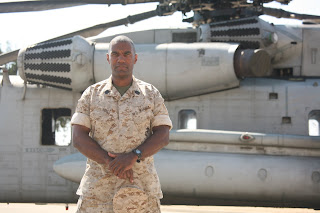
The 13th Marine Expeditionary Unit’s command element gathered at Artillery Firing Area 15, Camp Pendleton, Calif., today in formation to bear witness to the departure of Sgt. Maj. Enrique X. Hines, outgoing sergeant major, 13th MEU, and to welcome his replacement, Sgt. Maj. Juan M. Hidalgo.

After more than four years with the 13th MEU and 30 years in the Marine Corps, Hines relinquished his final position and bid farewell to the last Marines he would ever lead—April 9 marks his retirement date.

Following the traditions of the Marine Corps, a symbolic noncommissioned officer’s sword was passed from the outgoing sergeant major to the incoming recognizing the passing of responsibility from Sgt. Maj. Hines to Sgt. Maj. Hidalgo.

“It’s been a good ride,” said Hines who hails from the Republic of Costa Rica. “It’s bitter sweet, I’m happy to be leaving, but it’s tough.”


Hines addressed the senior leadership, his peers and Marines while reminiscing on all the good times he would miss.

He left his soapbox shortly after stepping on it, but not without leaving a few words of wisdom for the man who now claims the title of 13th MEU sergeant major.

“You will definitely see the spirit of the ‘Fighting Thirteenth’,” said Hines to Hidalgo. “You’re coming into a great unit.”

He told the incoming sergeant major that he could not have asked for a better replacement and that his reputation preceded him.

Hidalgo, formerly the command sergeant major for 3rd Assault Amphibian Battalion and native of San Diego, said he looked forward to serving with the Marines of the 13th MEU and answered a question that was running through all the Marines’ heads. What kind of sergeant major was coming to lead them? His answer was short, simple and to the point.

“We’re going to follow the Marine Corps standard,” said Hidalgo.

The history of the “Fighting Thirteenth” now rests in the hands of their new sergeant major, and their future of outstanding service will be based on his ability to lead the command element to success; a concept not unfamiliar to the Marines now under his charge.

“I’m losing my battle buddy,” said Col. David W. Coffman, commanding officer, 13th MEU. “I had the best battle buddy in the Marine Corps and I’m gonna miss him.”

Turning to his new battle buddy, Coffman welcomed Hidalgo to the unit and said he looked forward to the many good times to come.

Monday, February 8, 2010

13th MEU turns 25

Story and photo by Sgt. Jimmy Green
Monday, Feb. 1, marked the 25th anniversary of the 13th Marine Expeditionary Unit's inception.
Exactly 25 years ago here, the formerly named 13th Marine Amphibious Unit was activated.
Approximately three years later, the name changed to its current title.
From 1990 to 1995, the 13th MEU participated in Operations Desert Shield and Desert Storm in Southwest Asia, and Operation United Shield in Somalia.
From 1996 to 2007, the MEU participated in Operation Southern Watch, Southwest Asia; Humanitarian Assistance Operations in East Timor; Operation Determined Response, Yemen; Maritime Interception Operations, Northern Arabian Gulf; and Operations Enduring Freedom and Iraqi Freedom.
The 13th MEU's few returning veterans this year include Lt. Col. Ronald A. Stephens, the unit's future operations officer.
"I did two floats from 1993 to 1995," Stephens recalls. "I first came to the MEU as a replacement for a lieutenant who was medically evacuated."
During his time with the 13th MEU, Stephens served as the Engineer Detachment officer in charge. He participated in Operation United Shield, Operation United Nations in Somalia and Operation Continued Hope.
After Stephen's first float, he extended his contract to deploy a second time, which departed U.S. soil only six months after his first deployment with the MEU ended.
Ironically enough, Stephens deployed on the USS Comstock, a ship that was a part of the 13th MEU's most recent deployment.
Even with the changes in the MEU from then to now, Stephens is eager to get out again for a third time with the "Fighting Thirteenth."
"It seems like we had a lot more liberty back then, even when we were operationally committed," said Stephens. "But I will say that today's MEU is a lot more capable."
Through the various changes over the last 25 years, the 13th MEU still remains 'most ready when the nation is least ready' and is currently preparing for their 2011 deployment.
Stephens, along with the rest of the 13th MEU team, is optimistic and excited to see what the next float will bring to the table.

Exercise Iron Fist Kicks Off Joining US and Japanese Forces

Story and photos by Sgt. Jimmy Green

The 13th Marine Expeditionary Unit welcomed the Japanese Ground Self Defense Force to Camp Pendleton today for the fifth iteration of Exercise Iron Fist.
Exercise Iron Fist is a three-week bi-lateral training event between the Marine Corps and JGSDF designed to increase the interoperability between the two services while aiding the Japanese in their continued development of amphibious capabilities.
Senior officers participating in the exercise expressed their appreciation and excitement for the upcoming training.
"We are grateful for the opportunity to train with and learn from our friends in the Japanese Ground Self Defense Force," said Col. David W. Coffman, commanding officer for the 13th MEU.
Coffman, a native of Eustis, Fla., said he was delighted to have the opportunity to host the JGDSF and repay them for the tremendous hospitality they have long-offered American forces in their country.
The JGSDF and Marine Forces Pacific share a common virtue of increasing bilateral training and exercises. Exercise Iron Fist will allow both services to focus on amphibious operations and Marine Corps-JGSDF interoperability.
"We are able to operate functionally back at home," said Lt. Col. Hironobu Tanaka, officer in charge of the JGSDF attending the exercise. "This is a great chance for us to operate jointly with another organization and practice interoperability skills."
Tanaka said he is very excited to train in southern California and looks forward to learning from the Marines and sailors.
"This is a big facility, we don't have the infrastructure to do this in Japan," said Tanaka.
Maj. Anthonol Neely, assistant operations officer with the 13th MEU, said this exercise will allow the Japanese to work processes and tools in a different environment to help in their nation's self defense.
The JGSDF prepared for ship life, honed their marksmanship skills and practiced amphibious landings before coming to participate in Iron Fist.
Along with the skills already possessed by the JGSDF, Marines working beside them will offer new tools for their toolbox. The JGSDF will train in amphibious staff planning, execution of amphibious operations, limited offensive and extensive defensive tactics, techniques and procedures.
"The skills they will gain will aid them in preparing for what they hope will never happen," said Neely who hails from Nashville, Tenn.
While this is Neely's first time participating in Iron Fist, he said he feels it will be rewarding.
"Anytime we get a chance to work with coalition forces is beneficial because we get an opportunity to facilitate working with them in the future," said Neely. "It makes us more well-rounded. It presents an opportunity to learn about different cultures and it will be a learning experience for all involved."

Friday, January 22, 2010

Bronze Star Medal


Lt. Col. Ryan Coughlin, operations officer, 13th Marine Expeditionary Unit, receives the Bronze Star Medal on Jan. 20, 2010. Coughlin was awarded the medal for his duties as Military Training Team chief for the 29th Iraqi Army Brigade. He and his team of 18 Marines and one sailor advised the IAB. Photo by Sgt. Jimmy Green

13th MEU holds combat lifesaver course in preparation of deployment

Story and photos by Sgt. Jimmy Green


With the increasing number of Marines deploying, corpsman are out-numbered and overwhelmed. Being proactive to the lessons learned in combat, the 13th Marine Expeditionary Unit’s command element held a combat lifesaver course to prepare Marines to aid corpsman in the unfortunate event of mass casualty situations. This would allow more Marines to provide first aid than the corpsman could administer at one time.
The first combat lifesaver course of the rotation was held Jan. 4-7. Fourteen Marines from various sections of the command element to include combat camera and intelligence were trained on how to be first responders. Rank or billet did not discriminate. The course was built with students ranging from lance corporal to major.
The intensive four-day course prepared Marines to deal with burns, fractures, collapsed lungs, sucking chest wounds, hemorrhages, hypothermia and treating for shock.
At the end of the course and throughout the curriculum, students were continuously tested on their knowledge through written exams and practical application.
“It’s a really good course as long as Marines take the material seriously,” said Sgt. Sukhwant-rajpal Gill, intelligence analyst with the 13th MEU command element. “It gives you a basic understanding of how to help Marines if corpsmen are limited. You can possibly save a wounded Marine’s life instead of standing by not knowing what to do.”
Gill, a native of Moreno Valley, Calif., said he had a brief understanding of the material before entering the class because his parents were both nurses and he had family that worked in the medical field, but nonetheless, he felt the course was still very beneficial.
“I definitely recommend this course to someone who has had no medical training, however, I think anyone could benefit from this class in some way,” said Gill.
Marines and corpsman alike both share Gill's idea.
"Having Marines go through the combat livessaver course is a force multiplyer," said Senior Chief Christopher W. Thorne, 13th MEU medical planner. "It allows corpsman to focus on the most critical injuries while Marines can help their buddies out."
Several CLS courses will be conducted before the 13th MEU deploys and refresher course for those who underwent the training will also take place.

Thursday, October 29, 2009

From the East coast to the West coast, Marine finds a happy place in the MEU

Story and photo by Sgt. Jimmy Green


Sergeant Fernando A. Brea did not join the Marine Corps for the some of the most common reasons you would hear when you ask a Marine why he or she enlisted. He did not join to follow someone’s footsteps, and he didn’t join to avenge the falling of the twin towers.
Brea did not hit rock bottom either, however, he felt he needed to re-prioritize his goals.
His parents, both first-generation emigrants to the United States, settled in Bronx, N.Y., and had Brea, their second child. A year later they moved to Union City, N.J., where their family lived until Brea turned 16.
“I lived a normal childhood, I went to school, played sports, nothing out of the ordinary,” said Brea, senior intelligence analyst with the 13th Marine Expeditionary Unit.
He was the first in his entire family to join the service, and did so without any real military influences and little to no knowledge of the Armed Forces.
Brea said his older sister is a big influence on his life. Before the military he followed her example and attended college immediately after high school.
“I went to Florida Atlantic University for two years working toward a broadcast journalism major, but my focus was off,” said Brea.
At that point, he was working full-time to pay for his education and his grades were starting to slip.
“I talked to my father one day when I was at a crossroads in my life—my grades were tumbling—and he mentioned the military,” Brea said. “He didn’t specify any one branch, he just thought the military would help get my priorities right.”
At the time, Brea had a friend that was just finishing Marine Corps boot camp and was given the opportunity to attend his graduation.
“That single moment did not make me want to join the Marine Corps, but it definitely opened my eyes,” Brea admitted.
Brea took his father’s advice and checked out all of the different branches before making a decision. After checking out his options, he decided he wanted to be a Marine combat correspondent—which is most similar to his broadcast journalism major.
“The recruiter told me that the combat correspondent [Military Occupational Specialty] was closed out, so I picked intelligence as a second option,” said Brea.
After completion of his MOS school, Brea was stationed in Okinawa, Japan. He spent two years there before reporting to the 13th MEU in July 2006.
“The Marine Corps was the best decision I made in my entire life,” said Brea. “I got to live in Japan for two years, supported humanitarian relief and met my future wife.”
Brea met his fiancé, a Navy corpsman, when he was admitted to the hospital overnight after having his tonsils removed in December 2006.
“She was the corpsman on duty,” he said. “I thanked her for taking care of me and asked to take her out to dinner, but she turned me down.”
Brea said she continued to turn him down due to the policy stating corpsman cannot date patients, so when he was released he called and asked her again—she said yes.
For Brea, his decision to join the Corps was the best choice he has ever made. His mother, a native of Ecuador, was weary of him joining the service, but now is what he calls the “typical Marine Corps mom.”
“If you walk into my mom’s house, you would think I was dead from all of the pictures of me in my uniform,” Brea laughed. “It looks like a memorial.”
His father, who hails from the Dominican Republic, remains proud. Both of his parents noticed a change in him for the better, and he noticed one himself.
“I’m definitely more mature and re-focused,” Brea stated.
Looking back, Brea is most proud of his efforts in Indonesia with the humanitarian relief after a tsunami hit the country in 2004.
“I always did volunteer work but nothing like that,” said Brea. “Growing up in New Jersey, I never thought I would be a part of something like that, or live in Japan for two years.”
Brea has been in the Marine Corps for six years now and said he plans on retiring after 20 years. He also plans on returning to school and finishing up his broadcast journalism degree.
He says his drive to continue his service derives from knowing that no matter where he gets stationed, he can make a difference just by doing his job.
“The reports I gather and present have the potential to save lives,” said Brea. “Not many people can say that.”
After obtaining his bachelors degree, Brea would be eligible to pursue an officer career, but plans to remain enlisted.
“From my observation of both the enlisted and officer ranks, I feel that enlisted Marines have more influence on junior Marines, and to me that’s what it is all about— making a difference,” Brea added.

Monday, September 21, 2009

Sgt. Maj. Hines: The light at the end of the tunnel

Story and photo by Sgt. Jimmy Green
His character and demeanor demand attention without a word being spoken. His collar insignia reaffirm that he has earned his place—his authoritative being is justified.
Sergeant Major Enrique X. Hines, 13th Marine Expeditionary Unit sergeant major, climbed up many steppingstones to get where he is today.
“I always say I was born a Marine,” said Hines as he reminisced. “There is a picture of me at four-years-old with a high and tight and everyone says I looked the same then as I do now.”
Hines, who hails from Costa Rica, Central America, moved to Bronx, New York when he was four years old. It was not long after that he came in contact with a Marine who very well may have planted a seed in his head that over the next 12 years would grow into a new way of life.
The Hines’ family are devoted Catholics. After Sunday service, Hines would notice that a few boys from the congregation were dressed in uniforms and he wondered what they did.
After looking further into his observation, he discovered they were boy scouts and brought to his mother’s attention that this was something he wanted to do.
“I was always one of those kids that liked to complete things,” said Hines. And that he did. The boy scouts proved to be more than a summer hobby for him. He went on to become an eagle scout. Hines’ scout master was a former Marine and often brought along some of his Marine buddies when they went places.
“At the time, I didn’t know the difference between Marines and Army,” said Hines. “I just knew they were some kind of soldiers.”
Although his scout master did not talk much about the Marine Corps, Hines said he noticed his discipline and the way he carried himself. He lived by a higher standard.
At age 16, Hines knew he wanted to join the military. He told his mother he wanted to join the Army and become a ranger. She told him to talk to his uncle, a captain in the Army 82nd Airborne Division, to decide if that is what he truly wanted to do.
“My uncle told me that if I was going to join the service then to go Marine Corps,” said Hines. “He explained to me that the Army was such a big machine that I would be seen as a number rather than an individual.”
His uncle went on to tell him about Marines he served with, and how he wished the Army had that camaraderie.
He talked to his uncle about the officer and enlisted options and decided he did not want to hop right back into school, so he chose to go enlisted.
Hines took his uncle’s advice and with his parental consent he enlisted in the Marine Corps in the 11th grade. He joined under an open contract with a ground option. He received the occupational specialty of combat engineer.
Having a background in martial arts, Hines arrived physically ready when he hit the yellow footprints. His passion for the martial arts led him to perform several collateral duties in that department throughout his career.
“I was always into martial arts,” explained Hines.” I went from the basics to a junior black belt, and got into competitions.”
Hines instructed every form of martial arts and hand-to-hand combat that he encountered throughout his tour. He went on to win championships in Japan and North Carolina. Currently, he dons a black belt with two red tabs signifying his second degree instructor trainer status in the Marine Corps Martial Arts Program.
Hines spoke of many proud moments during his almost 30 years of service. However, he said the one moment that sits at the top of his list would be looking forward to retiring as a sergeant major, achieving the grade of top enlisted Marine.
“When you’re a (private first class) you don’t think of retiring as a sergeant major,” Hines laughed. “You’re just trying to make sergeant.”
After achieving the rank of sergeant, Hines knew he wanted to go for 20 years of service before retiring.
From combat to conflict and back to combat over the past 29-and-a-half years, Hines has seen and been through a lot. He made it quite clear he wasn’t going to choose just one significant event, but instead a culmination of his entire career defined his most proud moment.
“I’ve had a lot of proud moments, it’s hard to pick just one,” Hines said. “Looking back, I would have to say everything I experienced over the last 30 years, put together, is what I am most proud of.”
With every life story comes a speed bump or two.
Hines had back surgery for two herniated discs as a first sergeant. He said he was put down hard for an entire month.
“I felt like I wasn’t going to walk to again,” he explained. “I couldn’t understand how I made it through combat tours as a combat engineer, with no injuries, and then all of a sudden I am incapacitated due to wear and tear.”
He said he didn’t know what was going on and the doctors couldn’t really explain it. He had to learn how to move, walk and re-learn all the basics in life that he took for granted.
“I really got a greater appreciation for life after that,” he said.
Regardless of his experience, he never lost motivation and never fails to offer advice to young Marines.
“I have a tattoo on my back that sums up my time in the Marine Corps. It’s four words: Love, Discipline, Spirit and Warrior,” said Hines. “It’s in kanji, because most things in kanji are symbolic.”
He explained love stands for love for the corps, family and things of that nature.
“You tend to take care of the things you love,” said Hines. Discipline is the key to success. He believes discipline allows you to do things you’d sometimes rather not. Spirit is how you attack things, he said.
“A good spirit is contagious,” he added. “And being a warrior is fighting for what is right, both mentally and physically.”
“Since day one in the Corps, I didn’t know if I would do 20, but I knew I was damn sure going to try,” said Hines.
One of his influences in particular led him to that decision.
“I had a first sergeant, 1st Sgt. Hampton in Camp Lejuene, N.C., who I believe was most influential to me,” he said. “After working for him, I said ‘hey, I need to emulate that guy, he is the epitome of what it means to be a Marine.’”
Hines believes his senior leadership definitely molded him, but his junior Marines made him most proud. He said getting a “going away” plaque from Marines he led has much more meaning than getting a meritorious service medal from someone who thought he did a good job.
“There is nothing better than a young Marine saying ‘you were the best sergeant major I ever had’,” Hines noted.
Hines said if he didn’t join the Marine Corps he would have most likely joined the police force. He has a passion for service, and if he couldn’t serve his country then he would serve his community.
“Coming to the completion of my 30 years, I must say it has been a pleasure. I can’t believe the magnitude of people I have met,” said Hines. “People make the Marine Corps, we should never forget that. “
Hines advises young Marines to choose their friends wisely because a good friend will take care of you. He affirmed that the Marine Corps is an institution that will stay in your life forever.
He plans to retire on St. Patrick’s Day, March 17, 2010—the birthday of the combat engineers.

Friday, July 31, 2009

Campbell selected for MCAA Air Crewman of the year

Story and Photos by Cpl. Robert C. Medina

Staff Sgt. Bryan Campbell, UH-1Y weapons and tactics crew chief instructor, Marine Medium Helicopter Squadron 163 (Reinforced), 13th Marine Expeditionary Unit, was selected for the Marine Corps Aviation Association Air Crewman of the Year award, July 28.
This award is given to those who indicate exceptional leadership and dedication to mission accomplishment.
Campbell, known by his peers as “Soup,” was awarded for his involvement in successfully integrating the new UH-1Y helicopter into the 13th MEU and Boxer Amphibious Ready Group during the “Venom’s” first operational deployment. As the H-1 flight-line lead, he earned 24 new maintenance qualifications which enhanced the department’s knowledge base and contributed to more than 80 percent readiness rate for its helicopters. Campbell also developed new tactics and procedures for a sea-based UH-1Y deployment and increased the combat effectiveness by training and evaluating 10 UH-1Y enlisted air crew, resulting in 95 air crew designations.
“He is a motivator and an example to his Marines and those around him,” said Maj. Mark “Biter” Angersbach, a UH-1Y pilot with HMM-163.
Angersbach also said Campbell is a Marine that naturally inspires and that other Marines want to be like him.
“Bringing this helicopter to the fleet is a big step in my community,” said Campbell, from Melbourne, Ark. “This is a very prestigious award that I am pleased to have won. I have to give credit to all the crew chiefs that took time to study for the flights, prepare the aircraft and be willing to learn.”
Angersbach said Campbell is an excellent crew chief instructor and that he combines a firm teaching style with patience and understanding.
“Without a question, he is one of the most capable staff noncommissioned officers I have worked with,” said Angersbach.
Campbell is currently on his way home from a seven month deployment in which he successfully conducted counter-piracy operations, straits transit security and sustainment training afloat and ashore.

Thursday, July 30, 2009

13th MEU Marines and sailors come home after seven month deployment

CAMP PENDLETON, Calif., (July 29, 2009) – The 13th Marine Expeditionary Unit (MEU) is scheduled to return to Marine Corps Base Camp Pendleton, Calif., July 31, after completing a seven month deployment in the Western Pacific and Middle East regions.

During this deployment, the 13th MEU/Boxer Amphibious Ready Group served as the theater reserve in the Central Command area of operations, prepared to rapidly execute a variety of missions from humanitarian assistance to decisive combat operations.

While deployed, the 13th MEU conducted five Theater Security Cooperation exercises in different countries, countless hours of sustainment training afloat and ashore and participated in counter-piracy operations off the coast of Africa.

A highlight of the MEU’s deployment occurred when USS Boxer (LHD-4) became the flagship for Combined Task Force 151 in support of counter-piracy operations in the Gulf of Aden and Somali Basin. For approximately three months, 13th MEU elements assisted in planning and executing a multitude of counter-piracy operations, including the hostage situation with Captain Richard Phillips and the Motor Vessel Maersk Alabama.

In total, the MEU successfully operated in over 13 different countries across the Pacific, Central and Africa Commands.

The 13th Marine Expeditionary Unit is comprised of a Command Element, Battalion Landing Team 1/1, Marine Medium Helicopter Squadron 163 (Reinforced), and Combat Logistics Battalion 13.

Boxer Amphibious Ready Group (BOXARG) is comprised of Amphibious Squadron 5, USS Boxer (LHD 4), USS New Orleans (LPD 18), USS Comstock (LSD 45), USS Lake Champlain (CG 57), Helicopter Sea Combat Squadron (HSC) 21 Detachment 3, Naval Beach Group 1, Assault Craft Unit 5, Assault Craft Unit 1, Beach Master Unit 1 and Fleet Surgical Team 5.

Sunday, July 26, 2009

Serving servicemen in the great outdoors

Story by Cpl. Robert C. Medina

Photos courtesy of American Valor Outdoors


Military men and women serve all over the world when deployed. But what do they do when they come home?

One Marine who dedicates his time to a unique program called “American Valor Outdoors,” which was formed in an effort to honor all of America’s services members and their many sacrifices, is Staff Sgt. Bradley M. Luke. (photo above)

Currently, Luke is on his way home from a seven-month deployment with the 13th Marine Expeditionary Unit embarked aboard USS Boxer (LHD 4), serving as the communications chief for Bravo Battery, Battalion Landing Team 1/1.
American Valor Outdoors provides service members a variety of all expense paid activities including hunting, fishing, shooting and even photography, to name a few.

“To date, we have taken military members from all branches of service—children who have lost a parent in the current conflicts, law enforcement personnel, fire fighters and numerous injured service members—who cherish the time away and look forward to some natural rehabilitation,” explained Derome West, a Del Rio, Texas native, president and founder of American Valor Outdoors.

Remembering back, Luke says he got started in AVO through a close friend.

“I was taken on a hunt for turkeys in Clay County, Texas,” said Luke, from Stockton, Ill. “It was actually a tournament with ten different TV shows competing; our team took first and second place. To say it was awesome would not do it justice.”

Since that event, Luke has been involved with AVO for about three years. He serves as a Marine liaison, helping put events together.

Luke says they will eventually start a TV show as all of the events have already been taped in high-quality video for the participants.
“The only thing that really sets us back is our work schedules and funding. We are non-profit and all of the money comes from banquets and fundraisers. Individual donations help some too,” said Luke.

West says the entire AVO staff works on a volunteer basis.

“It is the volunteer spirit and the caliber of volunteers we have that makes what we do a success,” said West.

“The entire staff knows first hand what sacrifice is,” said West. “We have all served our country in both peace and war. With our been-there-done-that experiences, we have a unique insight into the warrior spirit which, in turn, better enables us to provide a quality experience for our guests.”

West praises Luke’s commitment to this program.

“Staff Sgt. Luke has been instrumental in the success of (AVO). He has taken this challenge in true Marine fashion, met it head on with uncompromising standards and delivered the very best results,” said West. “His service to (AVO) reflects great credit upon himself and the entire Marine Corps.”

Luke says he feels his involvement shows that even as an active duty service member, he doesn’t take his brothers and sisters in the service lightly. He said he is willing to give his time and resources up to show his appreciation for their service.

“[My hunting trip] was one of the most memorable times I have ever had,” said Luke. “I want others to have the same experience I did. I have never had the honor of working with such a great group of guys except for the warriors I serve with.”

Thursday, July 16, 2009

Oleoresin Capsicum (OC) spray victims

Photos by Cpl. Robert C. Medina

Elements of the 13th MEU participated in Oleoresin Capsicum spray training on the flight deck of USS Boxer (LHD 4) July 15. As Marines were sprayed, they performed various nonlethal techniques at four different stations. Afterwards, they began the decontamination process with the help of water and wind. OC spray training is part of annual qualifications Marines must complete if required in their job field.


Monday, July 13, 2009

ACE completes wash down before returning home

Story by Lance Cpl. Megan Sindelar

Photos by Cpl. Robert C. Medina


USS Boxer, At sea— 13th Marine Expeditionary Unit’s Aviation Combat Element is conducting an agricultural wash down aboard USS Boxer (LHD 4) July 11-14 before entering the United States.


While USS Boxer and the MEU conducted their wash down in the Middle East after their last land-based exercise, the ACE continued flight operations.


Now, on the transit home, Marines with the ACE, or Marine Medium Helicopter Squadron (HMM) 163 (Reinforced), spend the daylight hours on the flight deck washing their aircraft.


“The purpose is to get all the foreign dirt off the aircraft before we return to the United States,” said Cpl. Ryan Keene, a Chicago native and UH-1Y Huey helicopter mechanic, HMM-163 (Rein.), 13th MEU.


Lieutenant Col. Brett M. Bartholomaus, HMM-163 (Rein.) commanding officer and Clarion, Iowa native, says that Marines are required to clean the outside of the aircraft and remove all panels. This gives a more detailed cleaning to the engine, transmission and underneath the floorboards to ensure no dirt remains from previous operations.


“Some Marines have never done this before, so it is a good learning experience for them,” said Bartholomaus. “It is also motivating for the Marines because they know that as soon as we get done we will hit Hawaii and then we’re home.”


The wash down is not fun, but having everyone up on the flight deck makes the days go by faster, says Keene.


The 13th MEU/Boxer Amphibious Ready Group are in the last stages of their seven-month deployment and are journeying through the Pacific Ocean in route home.

Saturday, July 11, 2009

Photos of the week from the Comstock

Photos by Cpl. Robert C. Medina


A CH-53E Sea Stallion delivers supplies to service members aboard USS Comstock (LSD 45). Among these supplies were cleaning materials to help battle the spread of an "influenza-like-illness," which has been a unwelcome guest across the fleet.


The well-deck of USS Comstock is flooded to allow a Landing Craft Utility boat to enter the stern of the ship. This craft was sent out originally to conduct maintenance on the deck tiles on the ship.


Marines aboard USS Comstock (LSD 45), smile for a photo.


Bad weather made for a pleasant display of lights in the evening sky during USS Comstock's transit near the Philippines Islands.


Bad weather made for a pleasant display of lights in the evening sky during USS Comstock's transit near the Philippine Islands.


Marines and Sailors aboard USS Comstock (LSD 45), look out across the open seas as USS Boxer (LHD 4), makes her way through the Philippine Islands as the sun sets.


Sergeant Sergio Mijares, maintenance chief with Maintenance Detachment, CLB-13, moves wooden pallets aboard USS Comstock (LSD 45), during a replenishment at sea.


Marines with Combat Cargo aboard USS Comstock (LSD 45), organize rope during a replenishment at sea.


1st Lt. Matthew D. Riggs, engineering officer with CLB-13, speaks to Marines during a Humanitarian Assistance Survey Team exercise aboard USS Comstock (LSD 45). Riggs was the HAST officer in charge for this evolution.


Lance Cpl. Scott T. McLaughtin, from Palmdale, Calif., a military policemen with CLB-13, straps down an axe to the back of a humvee while making final preparations to their vehicles during the long journey home.

Thursday, July 9, 2009

Tiger Cruise Update: from the 13th MEU Commanding Officer

Dear Families and Friends of the 13th MEU,

As many of you may know, a mild influenza virus has affected a number of Marines and sailors aboard USS Boxer and USS Comstock. The USS New Orleans has yet to report any cases, but we expect they will as well. The specific strain of flu is unknown, but it is contagious and generally characterized as “influenza-like-illness.” This means we are required to quarantine affected personnel and take other prudent measures to contain the virus and prevent a more widespread outbreak. At this time, affected Marines and sailors are recovering just fine under the care and supervision of our superior Navy medical team and every precaution is being taken to keep unaffected personnel in continued good health.

Due to the risk of spreading illness to our family and friends aboard ship, and thereby further complicating our efforts to contain this virus and get everyone healthy prior to our return to San Diego, I have made the decision to cancel the Tiger Cruise for all 13th MEU personnel across all three of our ships. The safety and health of our Marines and their families is our primary concern. I share your disappointment and regret you and your Marine will miss this experience.

We understand you have likely already purchased airfare to Hawaii and perhaps made other travel and lodging arrangements. Unfortunately, the Marine Corps cannot reimburse any costs. We will, however, provide a letter outlining the circumstances surrounding the cancellation for your use in negotiating refunds with your air carrier or other parties.

Your support to the 13th MEU over the past year has been inspiring. Your Marines have performed tremendously throughout the last seven months on deployment and we are all looking forward to the reunion at our home stations. I hope to see all of you at our return home celebration.


D. W. COFFMAN
Commanding Officer
13th MEU


For any questions, please contact your sponsor, unit Tiger Cruise Representative, or Family Readiness Officer. We will continue to post updates and answers to Frequently Asked Questions (FAQs) to the 13th MEU Blogsite.

Wednesday, July 8, 2009

Repairman works into family’s legacy

Story and Photos by Cpl. Robert C. Medina
Tucked away on the deck of USS Comstock (LSD 45), working out of a storage container, is a Marine who repairs communication resources and electronics.
For Cpl. Brenton F. Sangster, a personal computer/telephone repairman assigned to Maintenance Detachment, Combat Logistics Battalion 13, 13th Marine Expeditionary Unit, the love of gadgetry is in his heart, but the love of the Marine Corps is in his blood.
Sangster is the fourth generation to become a Marine in his family.
“Since I was a kid I always knew I wanted to become a Marine like my old man,” said Sangster.

“I am proud to carry on that tradition.”
Working with electronics is something Sangster takes great interest in.“I really like to take electronics apart then put them back together,” said Sangster. “The Marine Corps has taught me to put them back together properly so they work.”

Sangster said the Marine Corps is based on communication and if gear needs to be fixed, his shop will do their part in making sure it works properly.
“Our job is important because of the various communication components that we can fix,” said Sangster, from Mission Viejo, Calif. “If a piece of equipment goes down that is used for communicating, the mission can be jeopardized.”
Learning the proper way to handle sensitive pieces of equipment to protect them from shorting out is also important said Sangster.
“Sometimes all it takes is just a little of static electricity from the body to short out a component,” said Sangster.

When Sangster is not working on a computer or any other piece of equipment, he likes to help his fellow Marines with their own electronics.

“I like to help out other Marines here on ship if they have a broken iPod or laptop, we will take parts from other broken electronics and try to replace them,” said Sangster. “‘One broke is better than two broke’ we say around here.”

Sunday, July 5, 2009

Flight deck aerobics

Story and photos by Cpl. Robert C. Medina


USS COMSTOCK, at sea (June 24, 2009) – The occasional sound of music blares from the flight deck of USS Comstock (LSD 45). A group of Marines step awkwardly in unison and seem to be enjoying themselves, making the most of their workout.

The leader of this up-beat aerobics class—Staff Sgt. Colleen Wilcox, radio chief, Communications Detachment, Combat Logistics Battalion 13, 13th Marine Expeditionary Unit.


Wilcox, from Waterford, Mich., said she began participating in aerobics when she joined the Marine Corps. Through her dedication, she became a certified instructor through Aerobics Fitness Association of America (AFAA). She can officially teach both Marines and sailors.

“Before we came on deployment I taught on base with just my Marines at the gym,” said Wilcox.

“My class is an hour long,” she said. “I like to start out with some warm-ups, then some resistance workouts. We do upper body one day and lower body the next.”

Wilcox says it’s not always easy to find a spot on ship to have class. With all the different moving parts aboard the Comstock, space can be limited.

In addition to space constraints, it can also be a challenge to get diverse participants.

“As much as the male Marines might think they don’t like it and feel it’s more for women, I think it is great for everyone because it works their bodies out in different ways than they would normally do it,” said Wilcox.

Corporal Sarah L. Griffin, also with Communications Detachment, CLB-13, which is part of the 13th Marine Expeditionary Unit, has been attending classes throughout the deployment.

“I always volunteer to do [the class],” said Griffin, a native of San Clemente, Calif. “The bigger the class the more fun it is.”

When Wilcox teaches an aerobics class, she always takes a couple of Marines from her shop to change it up.

Griffin says her favorite part of the class is watching everyone try really hard to get the moves down.

“You get to see how uncoordinated people are sometimes,” said Griffin. She continued by saying,

“I like to change up my workouts, especially here on ship. I think everyone should try it at least once, it’s a lot of fun.”

13th MEU celebrates Independence Day at sea

Story by Staff Sgt. Matthew O. Holly
Photos by Staff Sgt. Matthew O. Holly,
Lance Cpl. Jesse D. Leger and Lance Cpl. Karl J. Launius

USS BOXER, near the Philippines (July 4, 2009)—For many, Independence Day means family, friends and perhaps a cookout. These long standing traditions proved to exist this day for the service members aboard USS Boxer (LHD 4) minus one key factor—family.
This rang true when speaking of a conjugal family in the classic since; however, service members often refer to their brothers in arms as their expanded family and were able to celebrate with one another in the form of a steel beach picnic (a picnic on the flight deck of the ship) this July Fourth.
“This is a very unique Fourth of July with it coming towards the end of our deployment,” said Sgt. Maj. Enrique X. Hines, 13th Marine Expeditionary Unit sergeant major and Bronx, N.Y. native. “This is a great time to spend with my extended family,” referring to his fellow Marines and sailors.
It was also a day where Marines, sailors and civilians aboard could kick back, take in the sights of the Philippine Islands and listen to jams pumped out by U.S. Navy Electricians Mate 1st Class Robert Plaza, a Fullerton, Calif. native, aka, DJ Rist.
“It’s a good opportunity to get people to relax and out of their daily routine,” said Staff Sgt. Versayn G. Reynaga, the motor transportation chief for Combat Logistics Battalion 13 and resident of Glenns Ferry, Idaho. “It was nice to enjoy the barbeque and get some sun.”
Staff Sgt. Derrick M. Rasmussen, staff noncommissioned officer in charge of the 13th MEU’s Radio Battalion detachment, agreed by saying there’s nothing better than a little fresh air, sunshine and a barbecue.


“The food was good,” said Lance Cpl. Dustin C. Davis, infantryman with headquarters platoon, Charlie Company, Battalion Landing Team 1/1, 13th MEU and Houston native. “It was a good change of pace.”

Davis continued by saying he spent the last few Fourth of July holidays at home with friends and family, but was happy to be able to spend time with his friends at the steel beach picnic.

The day concluded with the cutting of the nation's birthday cake. Although for some it was a good Fourth of July amongst friends, it is safe to say the Marines and sailors aboard USS Boxer long for the next holiday they can spend with their loved ones at home.
The 13th MEU/Boxer Amphibious Ready Group are in the sixth of their seven-month deployment and are journeying through the Pacific Ocean in route home.

Friday, July 3, 2009

Marines and sailors from USS Comstock hold Steel Beach Picnic

Photos by Cpl. Robert C. Medina

Service members aboard USS Comstock (LSD-45) enjoy a relaxing day during a steel beach function, June 21. This was a change of pace from the normal working day and enabled them to have a nice social gathering. Marines and sailors enjoyed cool sodas and a barbeque.


Tiger Cruise FAQ **UPDATE**

How do I know if my Tiger Cruise Package was received? How do I confirm my registration?
Contact your sponsor or Unit Tiger Cruise Rep.

Who is my Unit Tiger Cruise Rep?

For USS Boxer:

- Command Element: Sgt Carter Hilton =

Carter.Hilton@boxer.usmc.mil

- HMM-163 (REIN): Capt Jeremy Dohoney =

Jeremy.Dohoney@boxer.usmc.mil

- CLB-13: LT Angela Roldan-Whitaker =

Angela.RoldanWhitake@boxer.usmc.mil

- BLT 1/1: Staff Sergeant Jon Knight =

Jon.Knight@boxer.usmc.mil

For USS Comstock:

tigercruisecoordinator@lsd45.navy.mil

For USS New Orleans:

gressete@lpd18.navy.mil


Is the Medical Screening complete?
Yes. The Medical Officers have reviewed all Medical Questionnaires, and only a few Tigers were denied participation. The Medical staff’s decision to deny participation is never easy, but safety and availability of care is the primary concern. Everyone denied participation has already been contacted in person.

If I was medically unqualified for the Tiger Cruise, may I still participate in the Mini-Tiger Cruise on 31 July to 1 August?
In most cases, yes! Please contact your sponsor to enroll.

When must I embark on USS Boxer/Comstock/New Orleans in Hawaii?
23 July. No earlier; no later. Registration aboard ship is tentatively scheduled between 1000 (10:00 AM) and 2100 (9:00 PM) on 23 July. Please coordinate any late arrivals in advance with your sponsor. Tigers must spend the night on-ship on 23 July. Unfortunately, no boarding will be permitted on 24 July.

What if I arrive to Hawaii before 23 July, may I embark early?
Unfortunately, no.

Should I arrive to Hawaii before 23 July, will my Marine or Sailor be permitted to stay at my hotel with me?
The intent is to maximize the opportunity for you and your sponsor to spend time together in Hawaii. Please coordinate directly with your sponsor for details and his/her duty schedule.

I understand that Marines operate in buddy teams while participating in off-ship “liberty”. As a spouse, parent, friend, or family member, must my Marine/Sailor still be paired up with another Marine/Sailor on liberty? Or can I be my Marine or Sailor's liberty “buddy”?
The intent is to permit Marines to participate in liberty with their family and friends without a fellow Marine. Subject to approval from your Marine’s leadership.

Once in Hawaii, how do I find the ship? What do I do?
Most importantly, maintain continuous contact with your sponsor. They will be able to provide the most up-to-date information on ship schedules, pier assignments, and the registration process. The USS Boxer/Comstock/New Orleans will be docked at Pearl Harbor. Transportation plans to ship and base access at Pearl Harbor for Tigers are still being coordinated. Please review this FAQ regularly to check for updates.

Will transportation be available upon off-load of USS Boxer/Comstock/New Orleans at Camp Pendleton on 31 July?
Tentatively, yes. The transportation plan is still being coordinated for Camp Pendleton, Miramar, and Yuma, AZ. Please review this FAQ regularly to check for updates.